What an AI detection score really means
A percentage is not a verdict. How to read an AI-likeness score, its range and confidence, and why a fair decision needs more than a number.
 By the Entherion team
7 min read
Key points
- An AI detection score measures how closely writing matches AI patterns. It cannot show who wrote the text.
- The likely range and confidence level matter as much as the headline number, and short texts are less reliable.
- Formal writing and second-language writing can score as AI-like, while edited AI drafts can score low.
- Read the highlighted sentences and treat any score as one signal among drafts, notes and conversation.
You paste an essay into an AI detector and it comes back with 72%. The number looks precise, and it is tempting to read it as a verdict. It is an estimate about writing patterns, and it only helps if you know what it measures, how certain it is and where it tends to go wrong.
What a detector actually measures
An AI detector does not know who wrote a text. It has no record of the writer's keyboard, browser or drafts. What it has is the text itself, and a model trained to tell apart examples of human writing and examples of AI writing.
Text produced by AI tools tends to share some habits. WrittenCheck's explanation of how its scoring works lists a few of them: smooth, common phrasing, sentences of similar length, and repeated transitions such as "Furthermore". Its lighter built-in model also looks at how much sentence length varies, how often phrases repeat, and how specific the writing is. A detector weighs signals like these and produces a score for how closely the text matches what it has learned.
That is why the right way to describe a high score is "this text reads like AI writing", not "this text was written by AI". The first is what the tool measures. The second is a claim about a person, and it needs other evidence.
A score is not a percentage of AI words
The most common misreading is to treat 72% as "72% of this essay was written by AI". It means nothing of the kind. The score is a measure of how AI-like the whole text appears, on a scale from 0 to 100. A fully human essay can score in the middle, and a fully AI-written one can score lower than you would expect if it has been heavily edited.
On the WrittenCheck website, scores are grouped into three bands:
| Score | How the website describes it |
|---|---|
| 0 to 44 | Likely human |
| 45 to 69 | Mixed or unclear |
| 70 to 100 | Likely AI |
Bands like these are more honest than a single number, because they admit a large middle ground. A score of 52 tells you the signals point in different directions and the text cannot be placed with any confidence.
The range and the confidence level
A single percentage hides uncertainty. A better result also gives a likely range and a confidence level.
The likely range
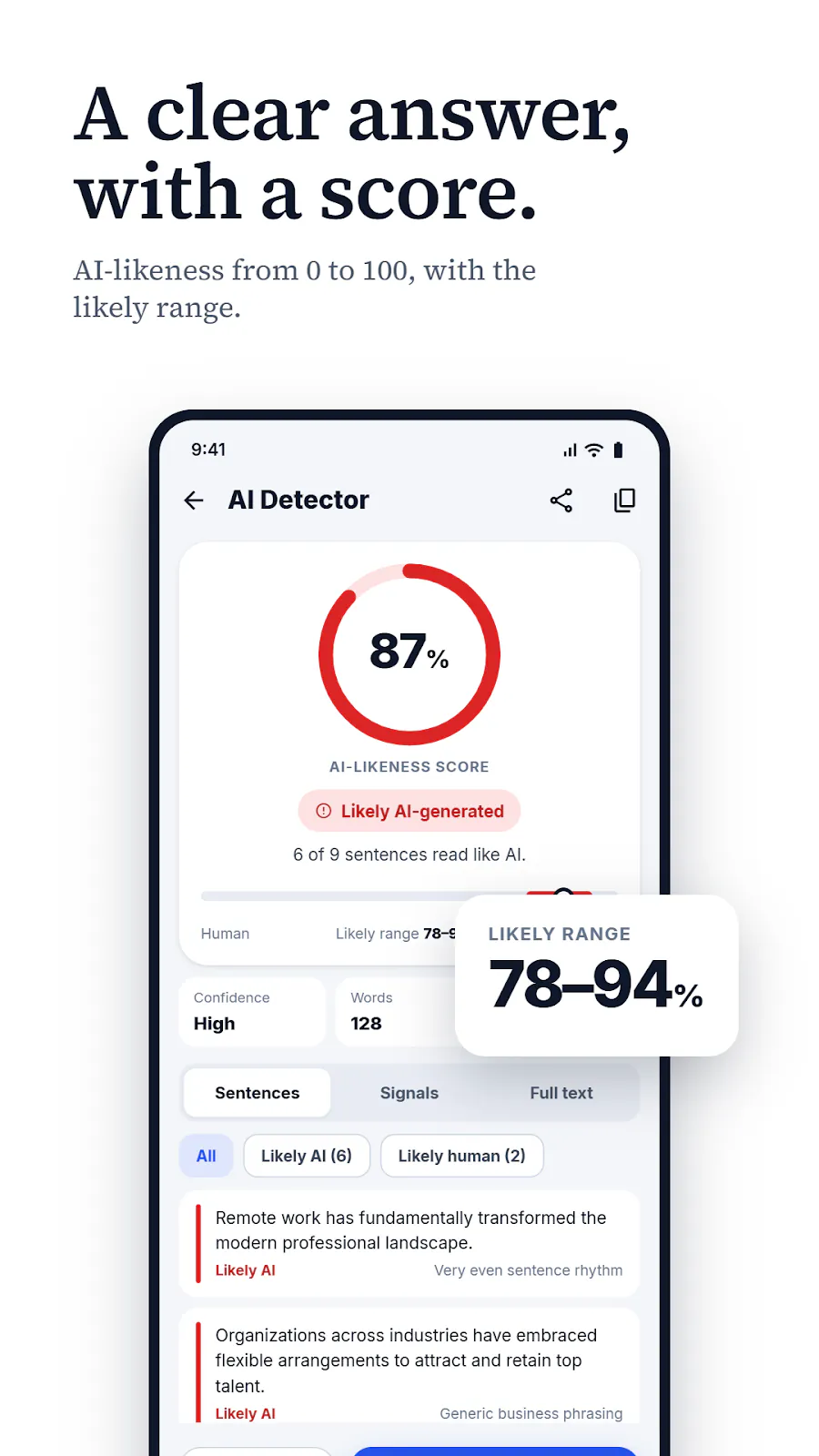
No detector is exact, so a range shows where the true score probably sits. "72%" on its own invites false precision. "60 to 84%" tells you the same text could reasonably have scored a good deal lower or higher. When a range crosses a band boundary, treat the result as unclear, whatever the headline number says.
The confidence level
Confidence describes how well the model's signals agree with each other. Short texts and texts that mix different styles usually get wider ranges and lower confidence. There is less writing to measure, and what there is may pull in two directions.
Length matters a great deal. WrittenCheck marks every result under 80 words as low confidence, and its website recommends checking a few hundred words for a more reliable result. It also reports that its deep English model caught about 85% of AI texts of around 40 words, compared with 199 out of 200 longer ones. A paragraph is not enough evidence to judge an essay.
Why mistakes happen: false positives and false negatives
A detector can be wrong in two directions. A false positive marks human writing as AI-like. A false negative misses writing that was produced by AI. Both are inevitable, and knowing where they come from helps you read a result fairly.
Writing that looks AI-like but is not
Some kinds of human writing are naturally regular and polished. WrittenCheck's own notes name several weak spots:
- very formal writing, such as abstracts and policy text
- simple, regular phrasing, which is common among people writing in a second language
- older literary writing in some languages, which its lighter built-in model finds harder to place
The point about second-language writers deserves extra care. A student who writes in careful, plain English because it is not their first language may produce exactly the kind of predictable sentences a detector associates with AI. A high score on that student's essay says very little on its own.
AI writing that slips through
The opposite also happens. AI drafts that have been edited or paraphrased usually score lower, and unusual AI styles, such as old-fashioned, technical or legal language, can be harder to catch. A low score is not a guarantee of human authorship either.
A worked example of scale
Even a small error rate matters when many texts are checked. WrittenCheck reports that in a test on 14 October 2026, its deep model flagged 0.47% of human English texts, counting a score of 45 or higher as flagged. That sounds tiny, and in a single check it is. Now imagine a school that checks 1,000 essays, all honestly written. A rate around half a percent would still flag four or five students who did nothing wrong. Test conditions also differ from real classrooms, so the rate in practice may be higher or lower.
This is the strongest argument against acting on a score alone. Somewhere in any large group of checks, an honest writer will receive a high number.
Read the sentences, not just the headline
A whole document is rarely all AI or all human. Someone might draft an essay themselves and use a tool to tidy one paragraph, or start from an AI outline and rewrite most of it.
Sentence-by-sentence highlights show where the AI-like patterns cluster. That gives you something to look at and talk about. A mostly human essay with one flagged paragraph is a very different case from a text that reads as machine-written throughout. Both can still land on a similar overall score.
When you read the highlights, ask practical questions. Is the flagged passage a definition or a summary, where most writers sound alike? Does it differ in tone from the rest of the piece? Does it contain specific details, such as names, dates or personal observations, or is it general?
What a score can and cannot tell you
| A score can suggest | A score cannot show |
|---|---|
| The text shares patterns with AI writing | Who wrote the text |
| Which sentences look most AI-like | Whether a tool was used for some, all or none of it |
| How certain the estimate is | Intent, honesty or effort |
| Whether a longer sample would help | Whether the text was copied from a source |
The last row is worth stressing. An AI detector is not a plagiarism checker. The WrittenCheck website states plainly that it does not compare text against web pages or papers. Copied human writing can score as human, because a person wrote it.
Using a result fairly
For students
Check your own work before you hand it in, especially if your style is formal or English is not your first language. Look at the flagged sentences, not just the score. Keep your drafts, notes and version history. They are far better evidence of your process than any detector result.
For teachers and examiners
Treat a score as a reason to look closer, never as a finding. Read the highlighted passages, compare them with the student's other work, and ask about the drafting process. A short conversation about how an essay was written usually reveals more than a percentage can. Be especially cautious with short submissions and with students writing in a second language.
For editors and publishers
A detector can help you prioritise which submissions to read more closely. It should not replace reading. Specific, checkable details and a consistent voice across a piece are often better signals than any score.
When a result looks wrong
Report it, if the tool allows. A detector's makers can only look into the mistakes they hear about, and a report with the text attached gives them something concrete to check.
How WrittenCheck helps
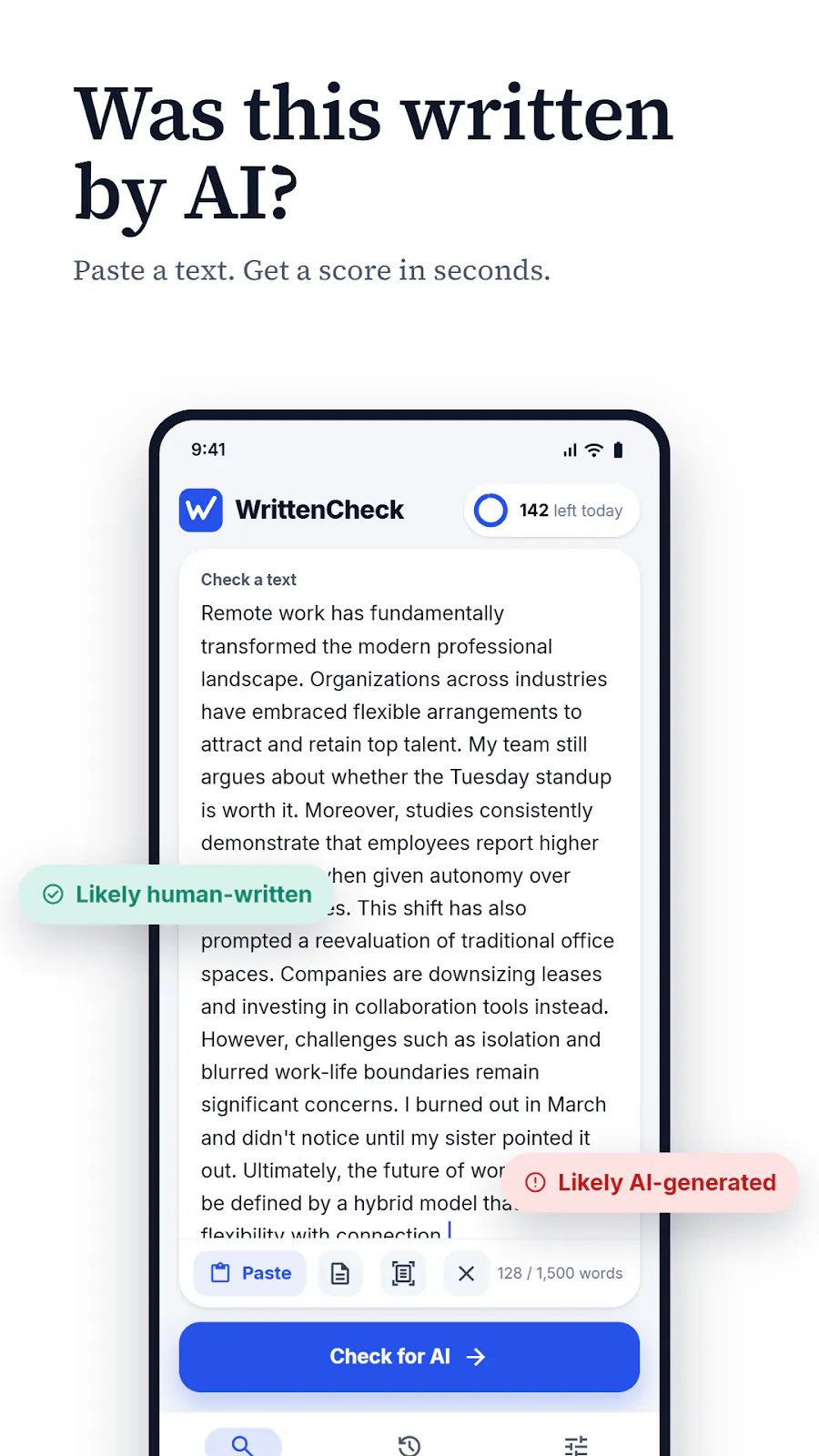
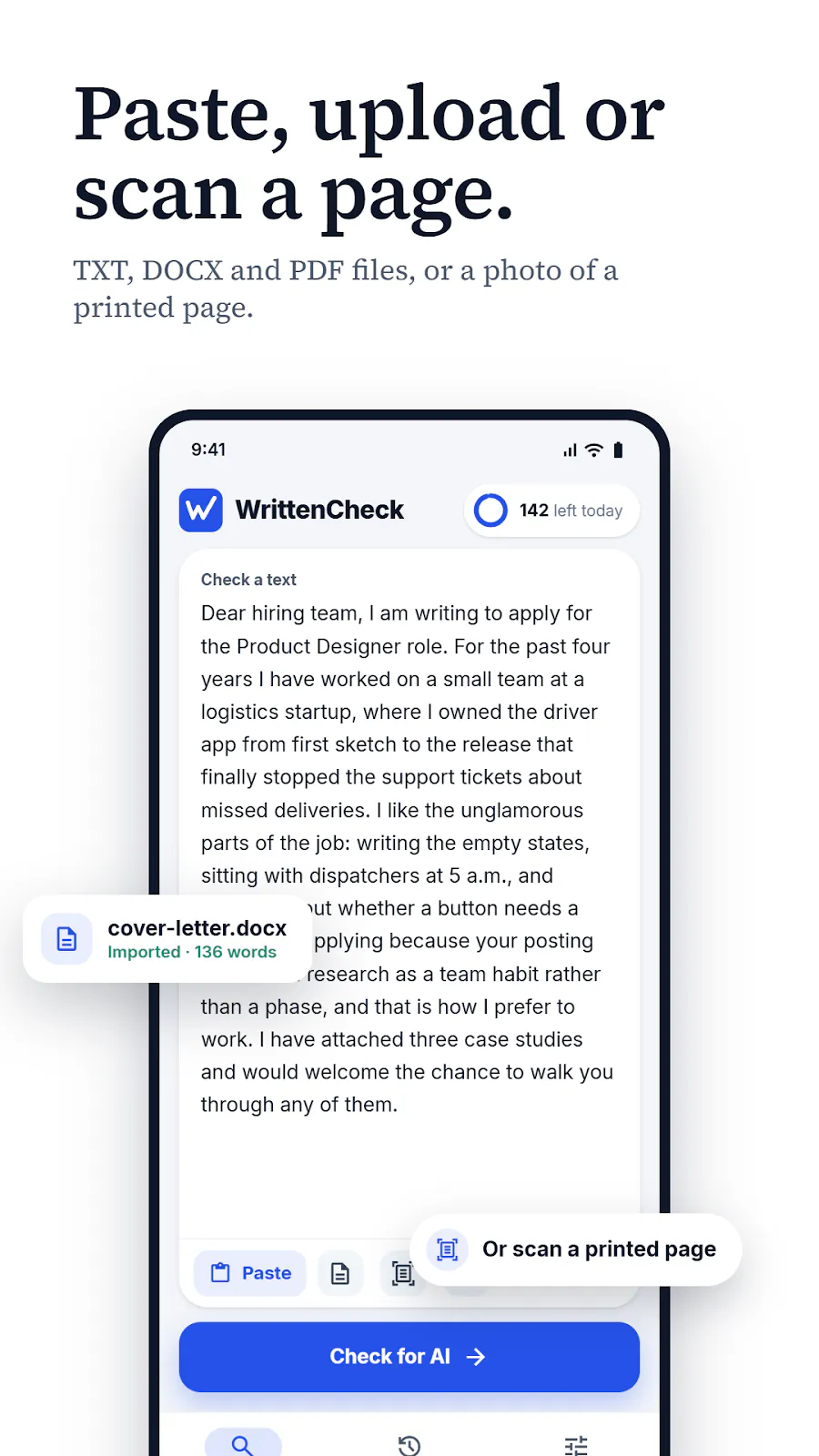
WrittenCheck: AI Detector for Android is built around the approach in this guide. It gives an AI-likeness score from 0 to 100% together with a likely range, a confidence level and a breakdown of what moved the score. Every sentence is marked as likely AI, mixed or likely human, so you can see which parts to read. You can paste or type 40 to 3,000 words, open TXT, DOCX and PDF files, or scan a printed page with your camera. Language is detected automatically across 16 languages.
There are 200 free checks a day, with no account or sign-up. Your text is checked and then discarded: it is never stored on the server or used for training. If a result looks wrong, you can report it from the result screen. The app treats a score as one signal, not proof, which is how any score should be read.
Questions people ask
Does a 70% AI score mean 70% of the text was written by AI?
No. The score estimates how AI-like the whole text appears. It is not the share of words written by AI and not proof of authorship.
Why are short texts less reliable?
There is less writing to measure, so the signals are weaker. WrittenCheck marks every result under 80 words as low confidence.
Can human writing be flagged as AI?
Yes. Very formal writing and the plain, regular phrasing common in second-language writing can look AI-like, which is why a score should never be used alone.
Is an AI detector the same as a plagiarism checker?
No. An AI detector looks at writing patterns. A plagiarism checker compares text against existing sources, which WrittenCheck does not do.