How to calculate your exact age from your date of birth
A reliable method for your age in years, months and days, with worked examples, month-end and leap-day cases, and the common mistakes.
 By the Entherion team
7 min read
Key points
- Count full years first, then full months, then the remaining days.
- Count days through the real calendar, never assuming 30-day months.
- Birth dates near the end of a month can give answers a day or two apart, depending on the convention.
- When a form names an "as on" date, calculate your age on that date, not today.
Most people can give their age in years without thinking. Ask for the exact figure in years, months and days and the answer gets slower, because months are different lengths and leap years add a day every so often. This guide sets out a method that works every time, walks through the cases that catch people out, and shows how to turn the result into weeks, hours and minutes.
Why exact age is harder than it looks
Years are easy because every year has a birthday. Months are harder. A month can have 28, 29, 30 or 31 days, so "one month" is never a fixed number of days. Counting days means stepping through a real calendar, including any 29 February that falls inside the span.
The Gregorian calendar, used for civil dates in most of the world, has a simple leap-year rule. A year is a leap year if it divides by 4, except century years, which must also divide by 400. So 2000 was a leap year and 1900 was not. Any count of days that skips this rule will drift by a day or more over a long life.
The three-step method
Work from the largest unit down. Each step uses the result of the one before.
- Count full years. Subtract the birth year from the current year, then take one away if this year's birthday has not happened yet.
- Count full months from the last birthday to the most recent date that has the same day of the month as your birth date.
- Count the remaining days from that date to today, using the real length of each month.
That is the whole method. The rest of this guide is about using it carefully.
Worked example: a straightforward case
Say you were born on 25 August 2001 and today is 13 November 2026.
- Years: 2026 minus 2001 is 25. The 25 August birthday has already passed this year, so you are 25.
- Months: from 25 August to 25 October is 2 months. 25 November has not arrived yet.
- Days: from 25 October to 31 October is 6 days, and 13 more take you to 13 November, so 19 days.
Your exact age is 25 years, 2 months and 19 days.
Worked example: when the birth day is later in the month
This is the case most people get wrong. Say you were born on 30 March 1998 and today is 13 November 2026.
- Years: the birthday has passed, so 28.
- Months: from 30 March to 30 October is 7 months. 30 November is still ahead.
- Days: from 30 October, count to the end of the month. October has 31 days, so that is 1 day, then 13 more to 13 November. The total is 14 days.
The answer is 28 years, 7 months and 14 days. The trap is assuming every month has 30 days. Had October been treated as a 30-day month, you would get 13 days and be one day out.
The month-end problem
Some birth dates have no match in shorter months. If you were born on 31 January, there is never a 31 February, and there is no 31 April, June, September or November either. Calculators handle this in different ways, and the answers can differ by a day or two.
Take a birth date of 31 January 2000 and a reference date of 1 March 2026. The years are simple: 26. The months and days depend on the convention.
| Convention | How it treats the missing date | Result after the 26 years |
|---|---|---|
| End-of-month | 28 February counts as the monthly anniversary | 1 month, 1 day |
| Strict day count | No full month has passed until 31 March | 0 months, 29 days |
Neither answer is wrong. They come from different definitions of a month. If two tools give you different results for a birth date near the end of a month, this is almost always why. For anything official, such as an eligibility date, use the convention the form or the rules specify.
Leap-day birthdays
If you were born on 29 February, three years out of four have no matching date. People and systems usually mark the birthday on 28 February or 1 March in common years. Which one applies for legal purposes, such as reaching voting or driving age, depends on where you live, so check the rule in your own country before relying on either.
For everyday use the choice matters little, as long as you stay consistent. Your age in days is unaffected, because a day count steps through the calendar and includes every leap day in the span.
Your age on a date other than today
Many forms ask for your age "as on" a particular date, such as the closing date of an application or the first day of a school year. The method is the same: use that date in place of today.
This is where mistakes cost something. An applicant who calculates their age on the wrong date can miss an age limit by a few days without noticing. If a form names a reference date, write it down before you start and count to that date, not to the day you happen to be filling in the form.
Turning age into weeks, hours and minutes
Once you know the total number of days, the other units are simple multiplication.
- Weeks: days divided by 7.
- Hours: days multiplied by 24.
- Minutes: hours multiplied by 60.
The hard part is the day count itself. Take someone born on 25 August 2001. Their span to 25 August 2026 is 25 years of 365 days, plus 6 leap days in 2004, 2008, 2012, 2016, 2020 and 2024. That is 9,131 days. From 25 August to 13 November adds 80 more: 6 left in August, 30 in September, 31 in October and 13 in November.
| Unit | Age on 13 November 2026 |
|---|---|
| Days | 9,211 |
| Weeks | 1,315 weeks and 6 days |
| Hours | 221,064 |
| Minutes | 13,263,840 |
These figures count whole days only. Without the time of birth, hours and minutes are a day-level estimate, which is accurate enough for curiosity and for most practical uses.
Common mistakes
Most errors fall into a handful of patterns. Check your working against this list.
| Mistake | What goes wrong | The fix |
|---|---|---|
| Assuming 30-day months | The day count drifts by one or two | Count through the real calendar |
| Forgetting the birthday has not passed | The age comes out one year too high | Compare month and day before subtracting |
| Skipping leap days | Long spans are short by several days | Add one day for each 29 February in the span |
| Counting the start day as well | Every day count is one too high | Count the days between, not both ends |
| Using today instead of a set date | Age limits are checked on the wrong day | Count to the date the form names |
The fourth one is subtle. From 25 October to 26 October is one day, not two. Count the gaps between dates, the way you would count nights in a hotel.
Checking the age gap between two people
The same method gives the exact difference between two birth dates. Treat the older person's birth date as the start and the younger person's as the end, then count years, months and days as before.
Take birth dates of 30 March 1998 and 25 August 2001. From 30 March 1998 to 30 March 2001 is 3 years. From there to 30 July 2001 is 4 months. The last stretch to 25 August is 26 days: 1 day to 31 July and 25 more. The age gap is 3 years, 4 months and 26 days, and it stays the same for life.
How Age Calculator helps
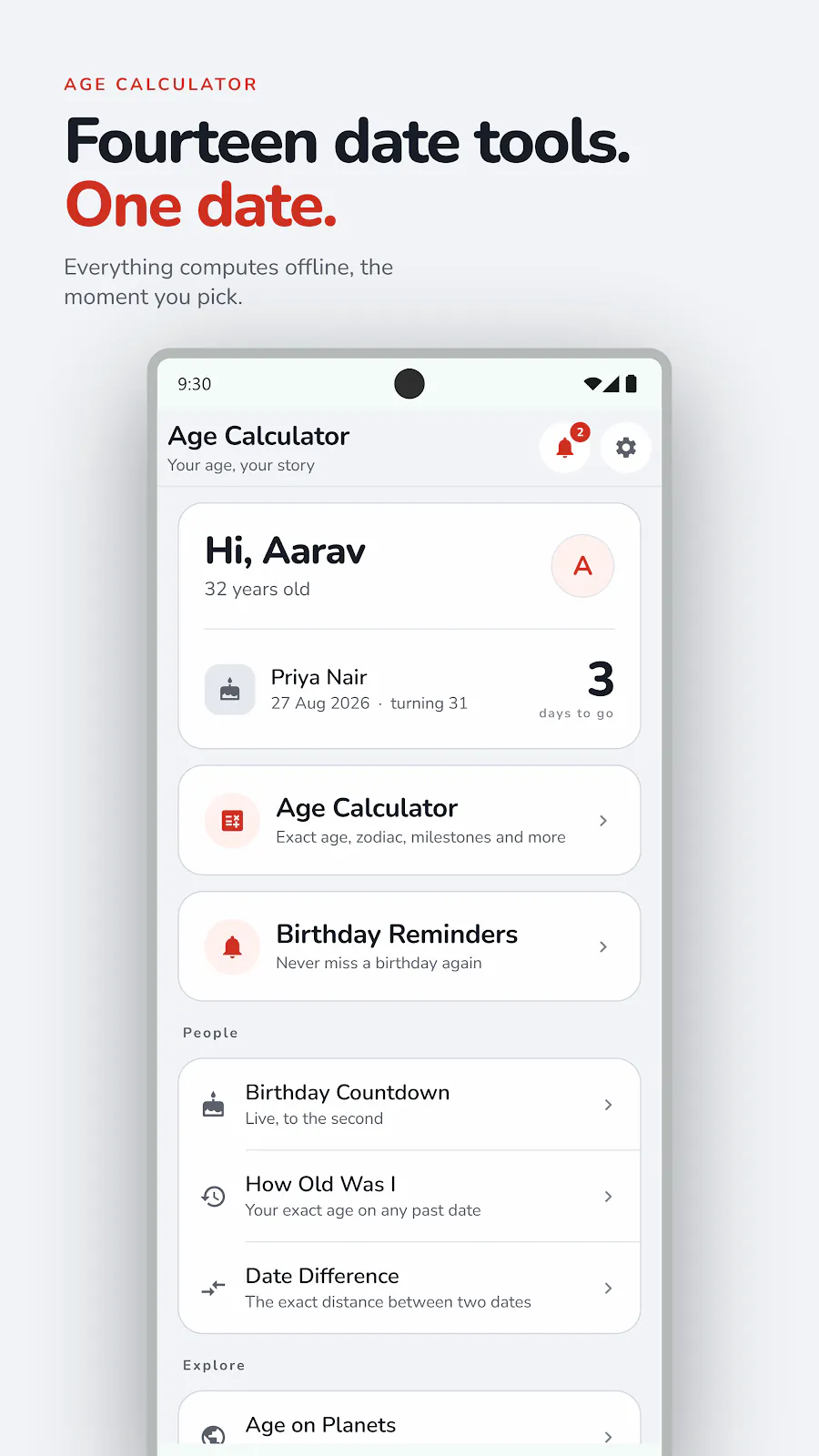
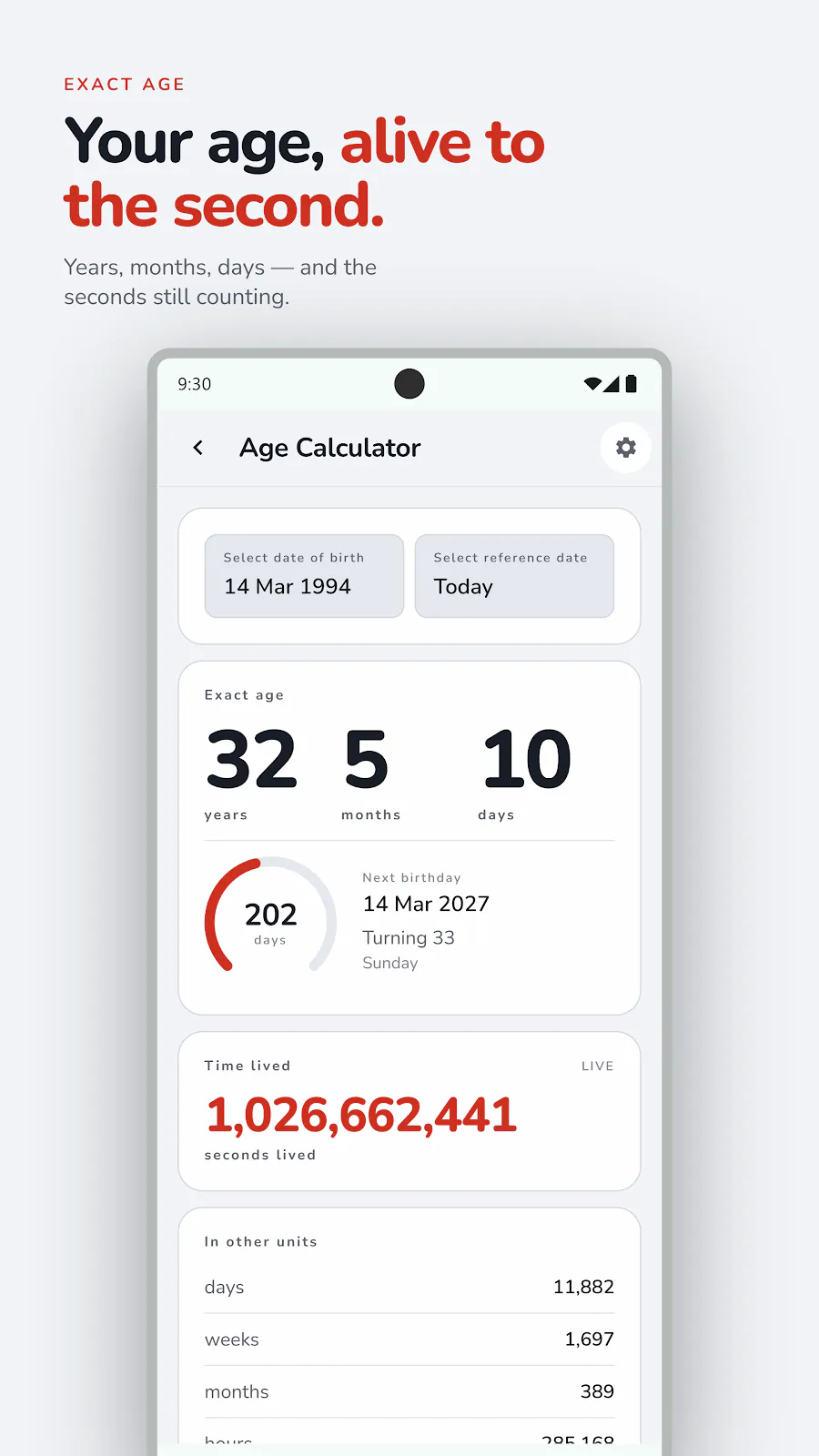
Counting by hand is worth doing once, so you know what the numbers mean. After that, a tool removes the risk of a slip. Age Calculator for Android shows your age in years, months and days, plus the same span in weeks, hours and minutes. You can move the reference date to see your age on any day, past or future, which suits forms with a fixed "as on" date. It also works in reverse, from an age to a birth date and the weekday you were born on.
The app also calculates the exact age gap between two people and the days between any two dates. It counts down to your next birthday and lets you save family birthdays with reminders. Every calculation runs on your phone, it works offline, and it needs no account. If you are at a computer, Age Finder Online offers free age and date calculators in the browser, and each tool shows its method and sources.
Questions people ask
How do I calculate my exact age in years, months and days?
Count full years since your last birthday, then full months to the latest matching day of the month, then the remaining days to today using the real length of each month.
Why do two age calculators give different answers?
Usually because of birth dates near the end of a month, such as 31 January. Calculators define a month differently when the matching date does not exist, so results can differ by a day or two.
How are leap-day birthdays handled?
In common years the birthday is usually marked on 28 February or 1 March. The rule for legal purposes depends on where you live, so check it locally.
How do I convert my age into hours or minutes?
Find the total number of days you have been alive, including leap days, then multiply by 24 for hours and by 1,440 for minutes.