Solving quadratic equations step by step
Factorising, completing the square and the quadratic formula, with worked examples, the discriminant and quick ways to check your answers.
 By the Entherion team
7 min read

Key points
- Rearrange the equation to ax² + bx + c = 0 before using any method.
- Factorise when the numbers are small and neat; use the quadratic formula when they are not.
- The discriminant, b² − 4ac, tells you how many real solutions to expect.
- Check answers by substituting into the original equation or with the sum and product of the roots.
A quadratic equation is any equation that can be written as ax² + bx + c = 0, where a is not zero. There are three standard ways to solve one: factorising, completing the square and the quadratic formula. Each has a situation where it is the quickest and clearest choice, so this guide works through all three with examples you can check line by line.
Before you start: get the equation into standard form
Every method below assumes the equation reads ax² + bx + c = 0, with everything on one side and zero on the other. Many textbook questions arrive in a different shape, and the first step is to rearrange.
Take x(x − 4) = 5. It is tempting to say x = 5 or x − 4 = 5, but that reasoning only works when the right-hand side is zero. Expand and move the 5 across instead:
x(x − 4) = 5
x² − 4x − 5 = 0
(x − 5)(x + 1) = 0
x = 5 or x = −1
Check x = −1 in the original: −1 × (−5) = 5. It works. The tempting shortcut would have given wrong answers.
Once the equation is in standard form, read off a, b and c with their signs. In 2x² − 3x + 7 = 0, b is −3, not 3. Most sign errors later on start here.
Method 1: factorising
Factorising rewrites the quadratic as a product of two brackets. It relies on the zero product rule: if two things multiply to give zero, at least one of them must be zero.
When a = 1
Look for two numbers that multiply to give c and add to give b.
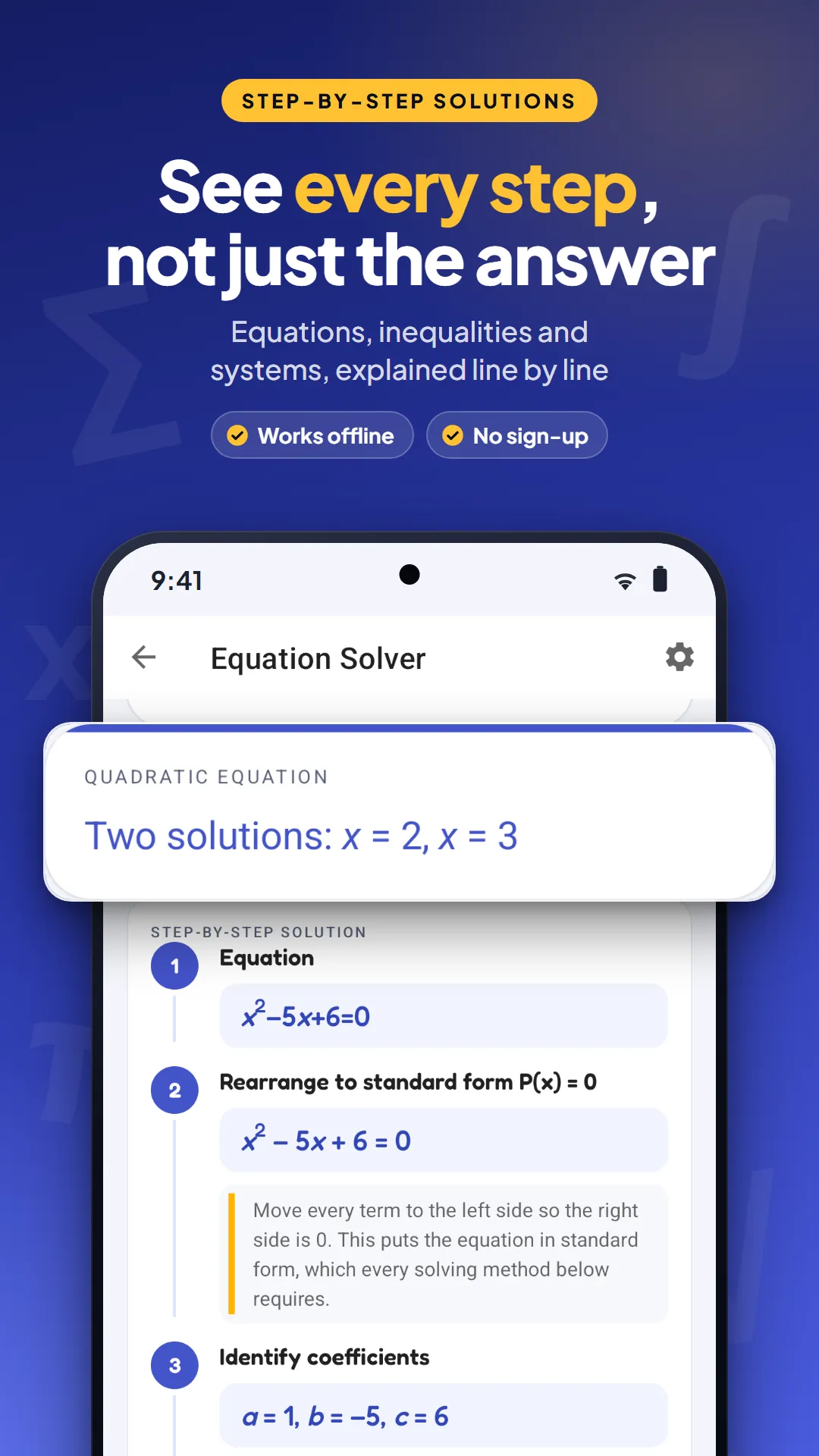
For x² − 5x + 6 = 0, you need two numbers with a product of 6 and a sum of −5. Those are −2 and −3.
x² − 5x + 6 = 0
(x − 2)(x − 3) = 0
x = 2 or x = 3
Check x = 2: 4 − 10 + 6 = 0. Check x = 3: 9 − 15 + 6 = 0. Both work.
When a is not 1: the ac method
For 6x² + 11x − 10 = 0, multiply a by c to get −60. Now find two numbers that multiply to −60 and add to 11. They are 15 and −4. Split the middle term using them, then factorise in pairs:
6x² + 15x − 4x − 10 = 0
3x(2x + 5) − 2(2x + 5) = 0
(3x − 2)(2x + 5) = 0
x = 2/3 or x = −5/2
Check x = 2/3: 6 × 4/9 is 8/3, and 11 × 2/3 is 22/3. Together that is 30/3, which is 10, and 10 − 10 = 0.
Don't divide by x
Faced with 3x² = 12x, many students divide both sides by x and get x = 4. That loses a solution. Dividing by x is only allowed if x is not zero, and here zero is one of the answers. Factorise instead: 3x² − 12x = 0 becomes 3x(x − 4) = 0, so x = 0 or x = 4.
Method 2: completing the square
Completing the square works on every quadratic, and it shows the shape of the graph along the way. It turns the equation into the form (x + p)² = q, which you can solve by taking square roots.
A worked example with a = 1
Solve x² + 6x + 5 = 0.
- Move the constant to the right: x² + 6x = −5.
- Halve the coefficient of x (6 becomes 3), square it (9), and add it to both sides: x² + 6x + 9 = 4.
- The left side is now a perfect square: (x + 3)² = 4.
- Take square roots, remembering both signs: x + 3 = ±2.
- Solve each case: x = −1 or x = −5.
The step people forget is the ± in step 4. A positive number has two square roots, and dropping the negative one loses half the answer.
When a is not 1
Divide through by a first. For 2x² − 8x + 3 = 0:
x² − 4x + 3/2 = 0
x² − 4x = −3/2
x² − 4x + 4 = 5/2
(x − 2)² = 5/2
x = 2 ± √(5/2)
Since √(5/2) equals √10 / 2, the exact answers are x = 2 + √10/2 and x = 2 − √10/2. As decimals they are roughly 3.58 and 0.42. Keep the exact form unless the question asks for decimals.
The bonus: vertex form
Completing the square also gives the turning point of the parabola. From the first example, x² + 6x + 5 can be written as (x + 3)² − 4. The graph of y = x² + 6x + 5 therefore has its lowest point at (−3, −4). That is often the reason a question asks for this method.
Method 3: the quadratic formula
The formula solves any quadratic. It comes from completing the square on the general equation ax² + bx + c = 0, so it always agrees with Method 2.
x = (−b ± √(b² − 4ac)) / 2aThe whole of the top line is divided by 2a, not only the square root. Writing it with a long fraction bar helps.
A worked example
Solve 2x² + 3x − 2 = 0. Here a = 2, b = 3 and c = −2.
- Work out the discriminant: b² − 4ac = 9 − 4 × 2 × (−2) = 9 + 16 = 25.
- Its square root is 5.
- Substitute: x = (−3 ± 5) / 4.
- Split the two cases: x = 2/4 = 1/2, or x = −8/4 = −2.
Check x = 1/2: 2 × 1/4 + 3 × 1/2 − 2 = 0.5 + 1.5 − 2 = 0. It works.
What the discriminant tells you
The expression under the square root, b² − 4ac, is called the discriminant. It tells you how many real solutions there are before you finish the calculation.
| b² − 4ac | Real solutions | Example |
|---|---|---|
| Greater than 0 | Two different ones | 2x² + 3x − 2 = 0 gives 1/2 and −2 |
| Equal to 0 | One repeated one | x² − 6x + 9 = 0 gives 3 |
| Less than 0 | None (two complex ones) | x² + 2x + 5 = 0 gives −1 ± 2i |
For x² + 2x + 5 = 0, the discriminant is 4 − 20 = −16. There is no real square root of −16, so the graph never crosses the x-axis. If your course covers complex numbers, √(−16) is 4i, and the solutions are (−2 ± 4i) / 2, which simplifies to −1 ± 2i.
Which method should you use?
| Situation | Best first choice | Why |
|---|---|---|
| Small whole numbers that factorise neatly | Factorising | Fastest, with the least arithmetic |
| The question asks for the turning point | Completing the square | Gives vertex form directly |
| a = 1 and b is even | Completing the square | Halving b keeps the numbers whole |
| Awkward numbers or no obvious factors | Quadratic formula | Always works |
| You only need to know how many solutions | The discriminant | One line of arithmetic |
A practical habit: spend ten seconds looking for factors. If nothing appears, move to the formula rather than forcing it.
Two ways to check your answers
Substitute back
Put each answer into the original equation, not your rearranged version. If you made a mistake while rearranging, checking against your own working will repeat it.
Use the sum and product
For ax² + bx + c = 0, the two solutions always add up to −b/a and multiply to c/a. For 2x² + 3x − 2 = 0, that predicts a sum of −3/2 and a product of −1. The answers 1/2 and −2 add to −3/2 and multiply to −1, so they pass. This check takes seconds and catches most sign errors.
Common mistakes
- Solving before the equation equals zero.
- Copying b with the wrong sign, especially when it is negative.
- Dividing both sides by x and losing the solution x = 0.
- Forgetting the ± when taking a square root.
- Dividing only the square root by 2a instead of the whole top line.
- Rounding too early, so the final answer drifts.
How Algebra Solver helps
The value of working by hand is in seeing each step. A tool is most useful when it shows the same steps, so you can find the exact line where your working went wrong. Algebra Solver for Android solves quadratics and polynomials up to degree 10 and shows the working one line at a time. Its calculator keeps exact fractions instead of rounding, so 0.75 stays 3/4. The graphing tool plots up to three functions and lets you tap a point to read its coordinates. That is a quick way to see where a parabola crosses the x-axis. All the maths runs on the phone, with no account, and the app supports TalkBack, so equations, steps and graphs can be read aloud.
On a computer, the quadratic equation solver on Free Algebra Solver shows its working and checks each answer. Use either one after you have tried the question yourself, and compare line by line.
Questions people ask
Which method is best for solving a quadratic equation?
Try factorising first if the numbers are small. Use completing the square when you need the turning point, and the quadratic formula for everything else.
What does a negative discriminant mean?
There are no real solutions, and the graph does not cross the x-axis. The equation has two complex solutions instead.
Why shouldn't I divide both sides by x?
Because x might be zero, and dividing by it loses that solution. Move everything to one side and factorise out x instead.
How can I check my answers quickly?
Substitute each answer into the original equation. You can also check that the two roots add up to −b/a and multiply to c/a.